Most fleets are fixing the wrong part of their mooring compliance program. The four major mooring frameworks have inverted the hierarchy: engineering is now the deliverable, documentation is the description. The work either converges in one cycle or repeats indefinitely against the same root cause.
EXECUTIVE SUMMARY
Where does a fleet actually start? Confronted with the four-framework reality, the instinct is always the same first move the document. A new Mooring System Management Plan (MSMP). A reissued LMP. A revised procedure. Paper is immediate, visible, and defensible in a meeting.
It is also the wrong starting point. SIRE 2.0 and RISQ 3.2, TMSA3 and DryBMS, SOLAS II-1/3-8, and the Terminal Framework no longer test whether the document exists they test whether it reconciles against the ship's engineering reality and the operational evidence it generates. A polished MSMP describing a system the vessel does not actually have is, in 2026, an active source of findings.
The correct order is: Gap Analysis first; then the Mooring Engineering Assessment Ship Design MBL, LDBF, TDBF, fittings SWL, equipment suitability, system design review; then MSMP and LMP reconciliation against that engineering basis; then operational evidence; and only then continuous compliance. Reverse it, and the rework loop runs indefinitely.
The Industry's False Starting Point
For two decades the deliverable in maritime compliance was the document inspectors checked binders, vetting analysts opened folders, surveyors reviewed plans and a whole generation was trained to treat it as the unit of compliance work.
The conditioning did not change when the frameworks did: SIRE 2.0 (September 2024) changed the deliverable, RISQ 3.2 (February 2026) tightened it, SOLAS II-1/3-8 made Line Management Plans mandatory from January 2024, and the Terminal Framework moved faster still.
Yet for many operators, SIRE 2.0 preparation and pre-vetting inspection readiness for tankers still mean producing, presenting, and defending paper and the same finding keeps resurfacing in a different framework or at a terminal, more polished each time.
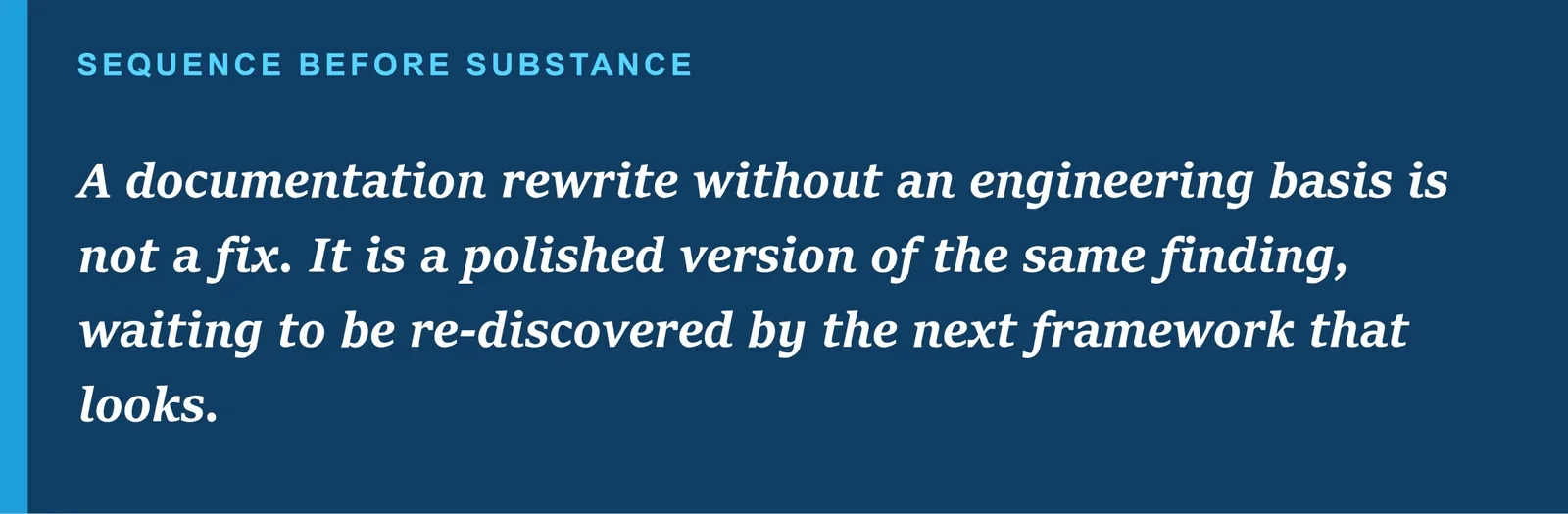
What the frameworks test has shifted: not whether a plan exists, but whether it reconciles against the ship has the Ship Design MBL it references actually been calculated, do the fittings SWL and the LDBF/TDBF values match what is installed and certified on board. Reconciliation cannot be achieved by rewriting the document. This is The Sequence Inversion: engineering is now the deliverable; the document is the language layer over it.
One Deficiency, Four Framework Surfaces
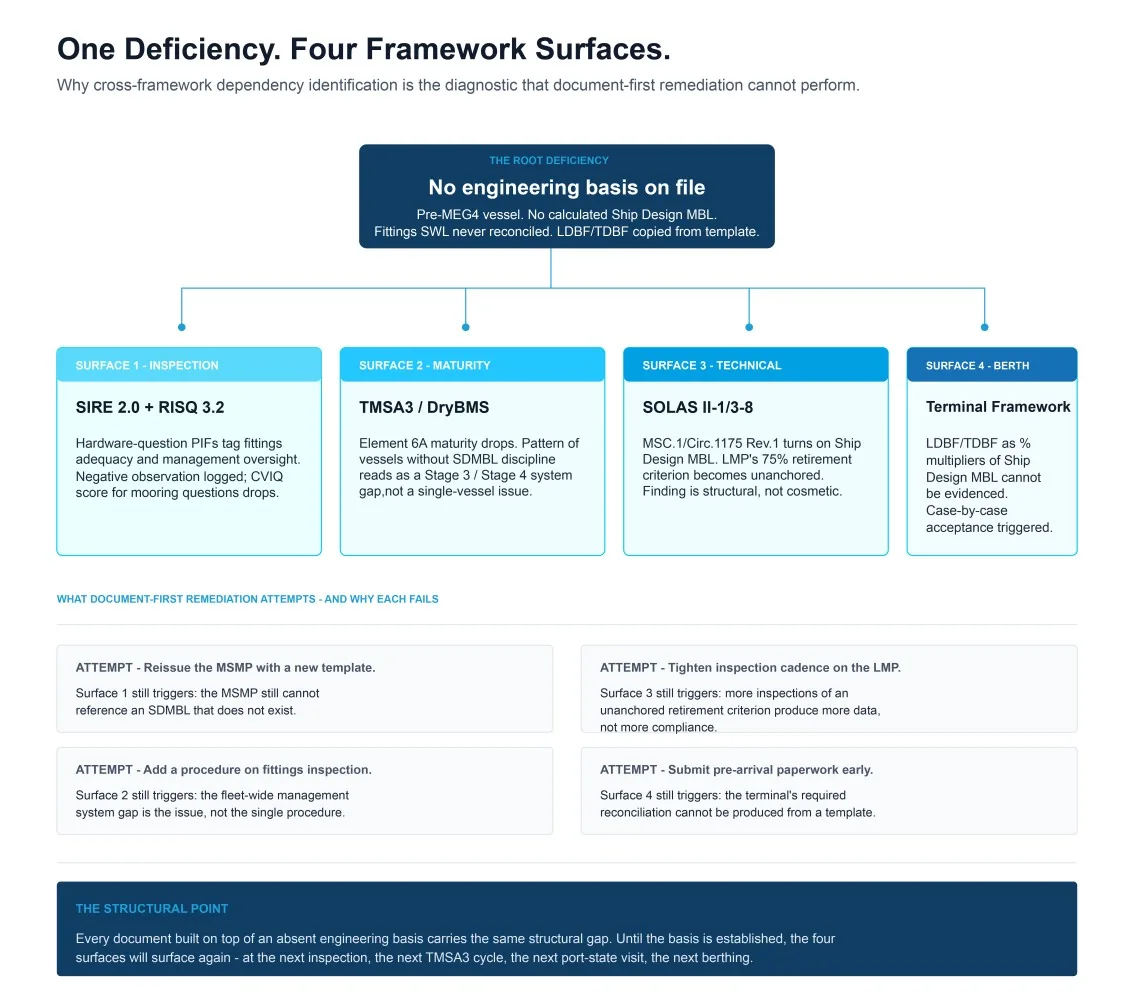
Consider a fourteen-year-old MR product tanker, built before MEG4. The MSMP comes from a template library; the LMP carries certificates for every line and tail. On paper the vessel looks fine. It has one structural deficiency no calculated Ship Design MBL on file so the fittings SWL has never been reconciled, and the LDBF and TDBF values were copied, not derived. That one deficiency surfaces in all four frameworks:
•Inspection lens (SIRE 2.0 / RISQ 3.2): a hardware observation the documentation cannot evidence the reconciliation; PIF tags accumulate and the CVIQ score drops.
•Longitudinal lens (TMSA3 / DryBMS): a maturity finding Element 6A reads a pattern of such vessels as a Stage 3/4 system gap, not fixable one ship at a time.
•Technical lens (SOLAS II-1/3-8): a structural finding MSC.1/Circ.1175 Rev.1 makes the Ship Design MBL the engineering basis; without it, the LMP's 75% retirement criterion is unanchored.
•Terminal Framework: a commercial finding terminals require LDBF and TDBF as multipliers of Ship Design MBL; with no anchor value, the vessel faces case-by-case berthing acceptance despite complete paperwork.
One deficiency. Four surfaces. None solvable by rewriting the MSMP.
The Gap Analysis Layer
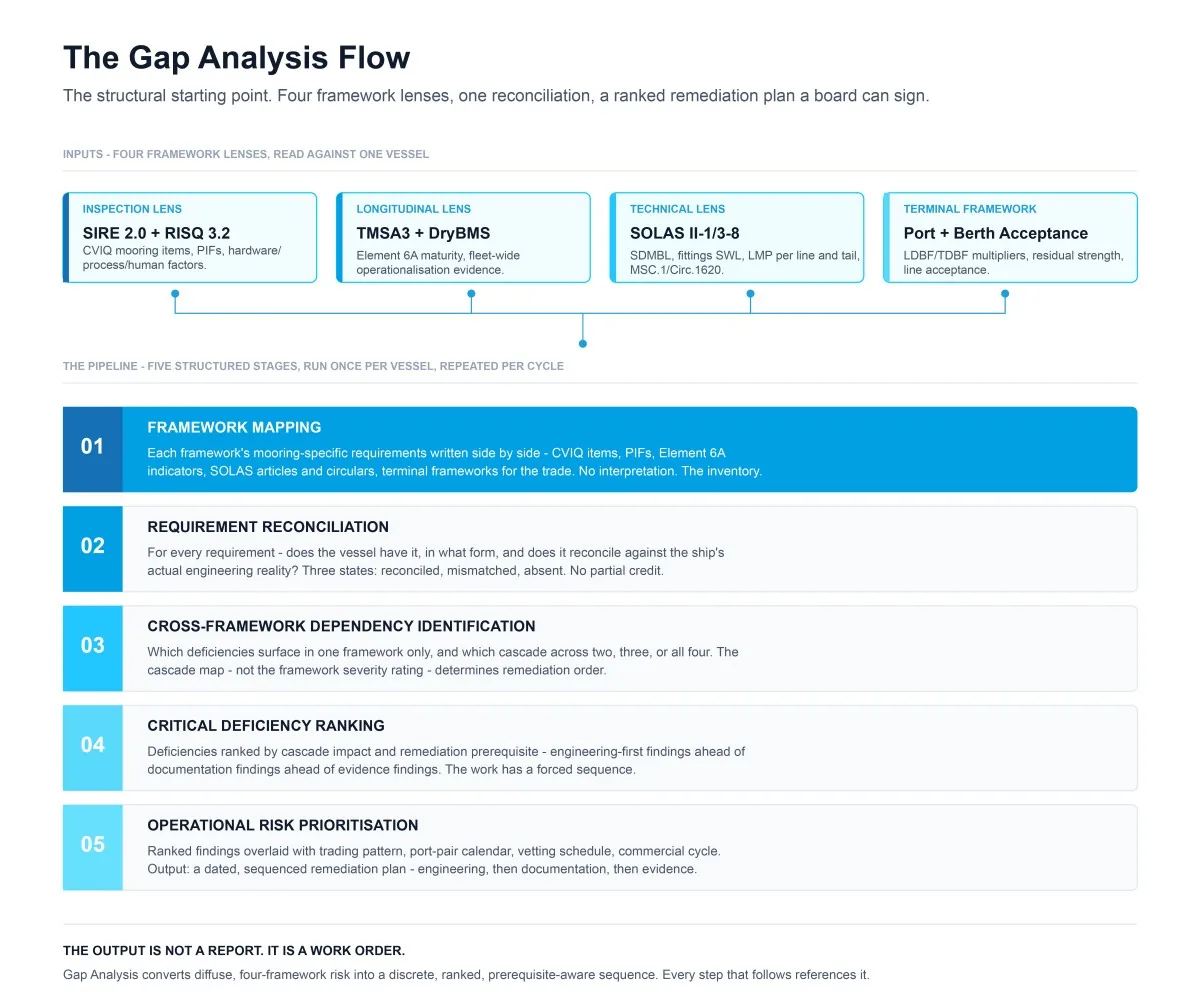
Gap analysis converts diffuse, multi-framework exposure into a discrete, prioritized remediation plan a board can sign and a superintendent can execute and it is the layer document-first remediation skips, because it produces nothing visible in a binder. In practice it is a TMSA gap analysis, a DryBMS gap analysis, and a RISQ gap analysis run against the same vessel in a single exercise four lenses, one reconciliation:
•Framework mapping: The side-by-side inventory of what each framework requires: SIRE 2.0's mooring-relevant CVIQ items and PIFs; RISQ 3.2's tightened dry-side mooring section, now the core of RightShip inspection preparation; TMSA3 Element 6A; SOLAS II-1/3-8 and its circulars (MSC.1/Circ.1175 Rev.1, 1619, 1620); and the terminals' published requirements on the trading pattern.
•Requirement reconciliation: Does the vessel have it, and does it reconcile against the ship's engineering reality? Three states only reconciled, mismatched, or absent. No partial credit; soft gradings are what create audit blind spots.
•Cross-framework dependency identification: A single-framework finding is a local fix; a four-framework finding is a root cause that requires upstream engineering before any downstream document holds.
•Ranking and risk prioritization: Deficiencies ranked by cascade impact and overlaid on the operating calendar trading pattern, vetting windows, drydock. The output is a dated, sequenced plan: engineering first, documents next, evidence behind them. That is what a board can sign.
The Mooring Engineering Layer
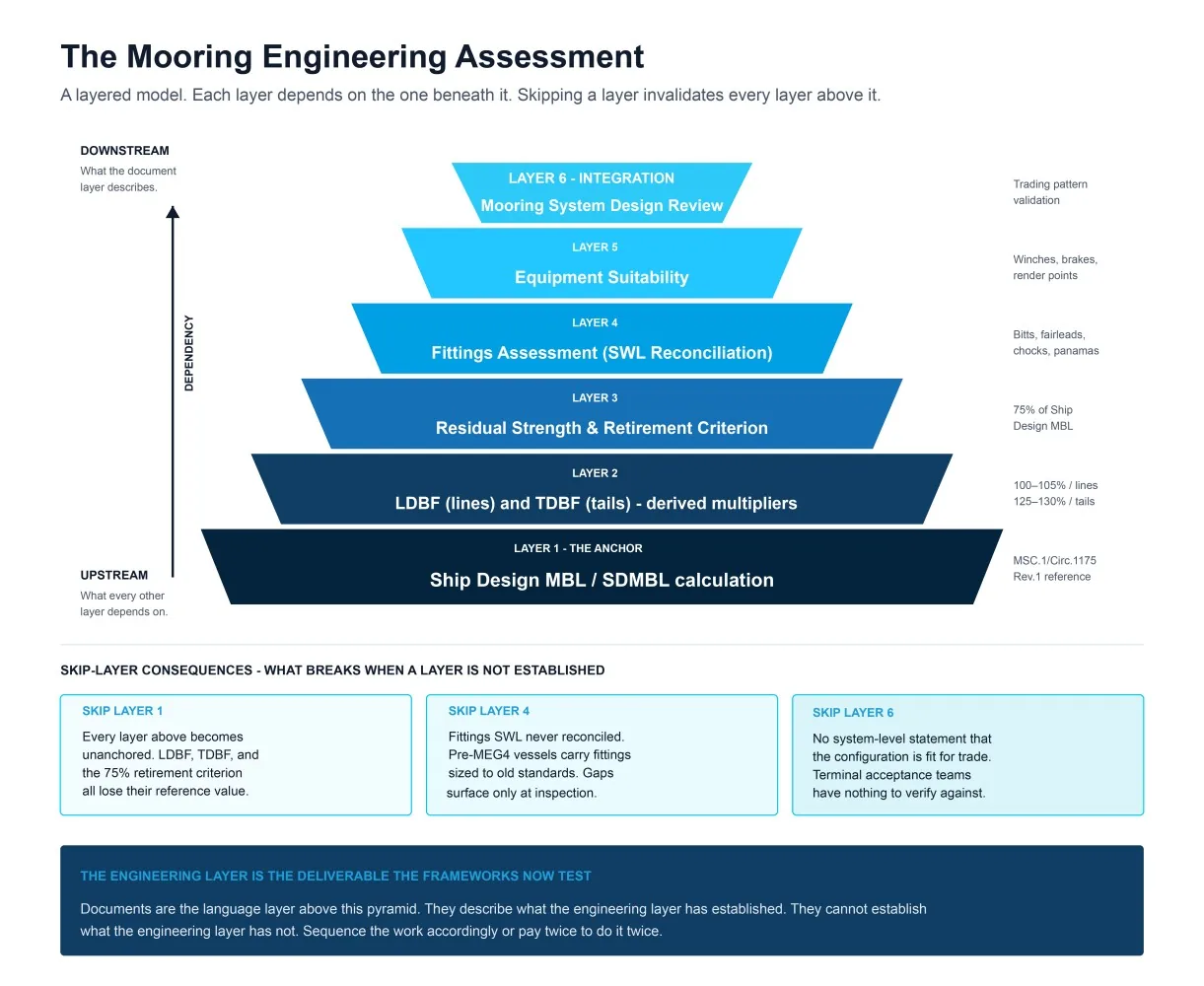
Gap analysis scopes the engineering; the engineering establishes the foundation everything else rests on. It is the layer most fleets are least equipped to perform not because it is exotic, but because mooring historically sat with the deck department rather than the technical function where the post-MEG4 frameworks now place it. MEG4 compliance is an engineering exercise before it is a documentation one and a structured MEG4 mooring equipment gap analysis is where it begins.
Six elements:
•Ship Design MBL (SDMBL): The engineering anchor under MSC.1/Circ.1175 Rev.1 as-built for MEG4 ships; for pre-MEG4 vessels, still the majority of the global tanker and bulk fleet, it must be calculated, documented, and accepted. Without it, every document above is mismatched by definition.
•LDBF: In-service line strength as a multiplier of SDMBL typically 100 -105% under MEG4. Derived, not copied from a template.
•TDBF: Tail strength at typically 125 - 130% of SDMBL, higher for exposed berths.
•Residual strength: The 75%-of-SDMBL retirement criterion terminals now apply as an acceptance threshold quantitative, not a judgement call.
•Fittings assessment: Each SWL bitts, fairleads, chocks, panama leads reconciled against the SDMBL and the actual line forces at the berth; on many pre-MEG4 ships the marked SWL is correct but the reconciliation reveals a gap.
•Equipment suitability and system design review: Winches, brake holding capacity, render set points checked against the new line and tail specifications, plus the integrated review against trading pattern and berth profiles. The output is a single engineering statement: the system, as configured, is fit for purpose the statement the MSMP then describes.
All of it is bounded, finite, one-time per vessel. Write the documents first, and you are writing description without a referent.
The Documentation Trap
The trap is set by incentives, not people. A document is fast, visible, and signed off at the level the work was commissioned; an engineering calculation is slow and invisible until integrated. Faced with a finding, the path of least organizational resistance is the document; the path the frameworks reward is the engineering. The trap cannot be escaped at the operational level only where engineering can be commissioned and the sequence enforced: technical director, fleet manager, executive sponsor. The Documentation Trap is not a documentation problem. It is The Sequence Inversion, disguised.
The Evidence Layer Becomes Compliance Intelligence
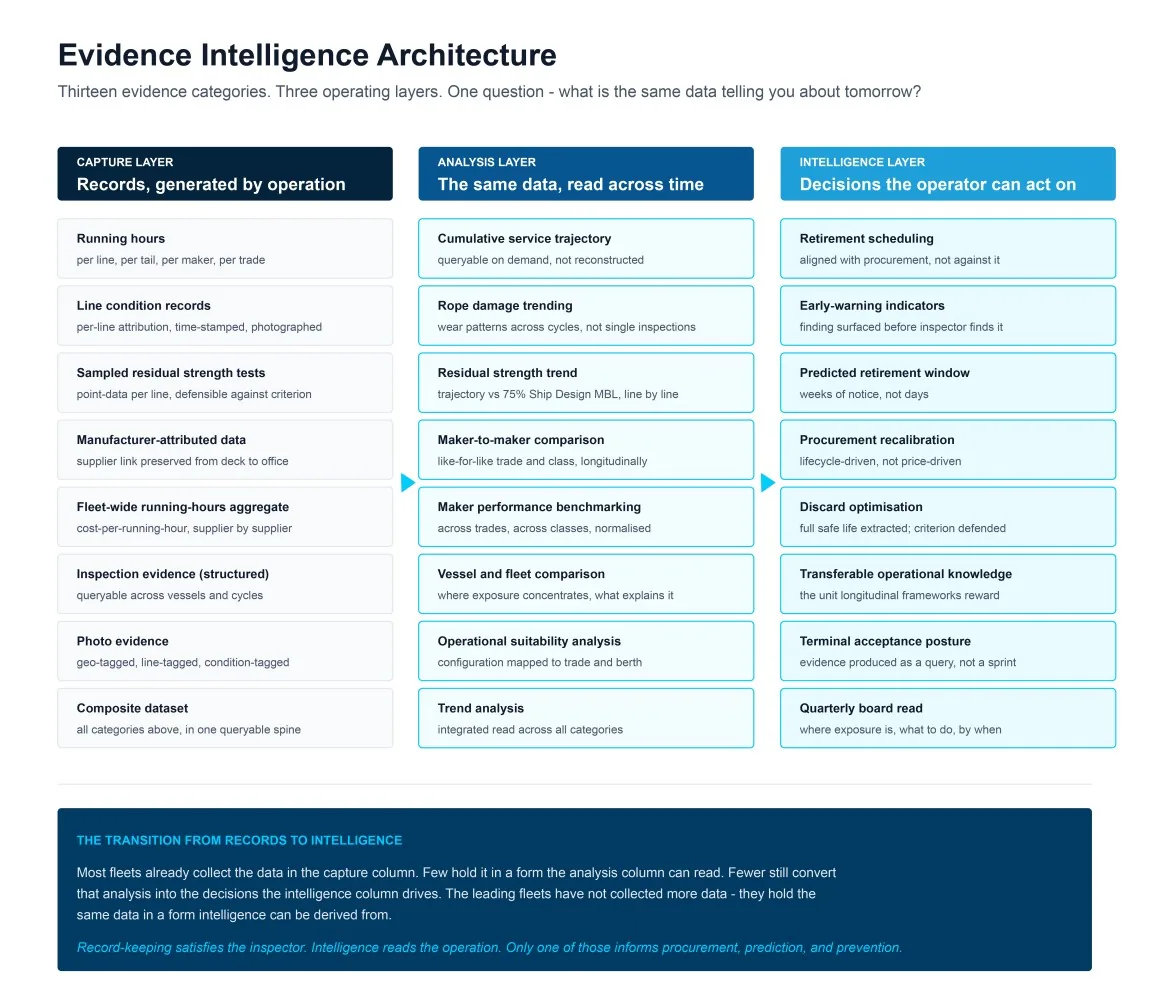
Once the engineering basis exists and the documents reconcile against it, the records the fleet already generates running hours, line condition, residual strength tests, photo evidence stop being records. They become an instrument.
This is Compliance Intelligence. Compliance management produces binders; Compliance Intelligence produces decisions the same data the inspector reads, read forward into procurement, retirement, and suitability instead of backward into the next mooring audit. The frameworks are converging on it: SIRE 2.0 questions, TMSA3/DryBMS longitudinal patterns, and terminal reconciliations all now assume a queryable evidence base that exists before the vessel arrives.
In practice: rope damage trending that flags deterioration before failure; residual strength plotted against the 75% criterion, giving weeks of retirement notice instead of days; maker benchmarking that shifts procurement from price-driven to lifecycle-driven. That is also the real test of mooring management software and of maritime compliance software generally: not whether it stores the binder, but whether it answers the inspector's question and the operator's from the same queryable spine. SIRE 2.0 compliance software that cannot be queried is a digital filing cabinet.
Case Study: A Fleet Remediating in Sequence
A mid-tier manager runs twenty-six vessels fourteen product tankers, twelve dry bulk, half the tanker fleet pre-MEG4. Five years of document-first remediation produced a SIRE 2.0 trend that flattened rather than improved, and one vessel turned away from a terminal in early 2026 over a residual-strength reconciliation the LMP could not produce.
A structural gap analysis across the fleet returns, six weeks later, a matrix the board can read: twenty-six vessels by four frameworks by roughly one hundred requirements every cell reconciled, mismatched, or absent. Eleven vessels carry a foundational engineering deficiency. One of them, MT Eastern Resolve, then runs the full sequence in five stages:
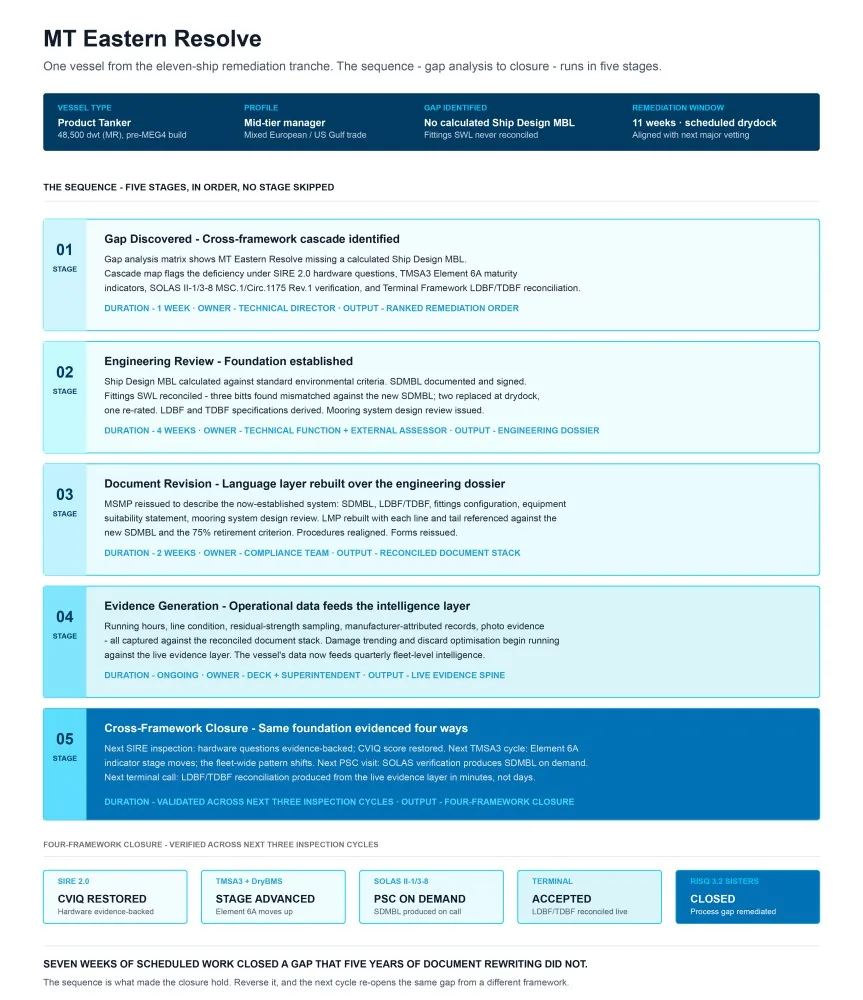
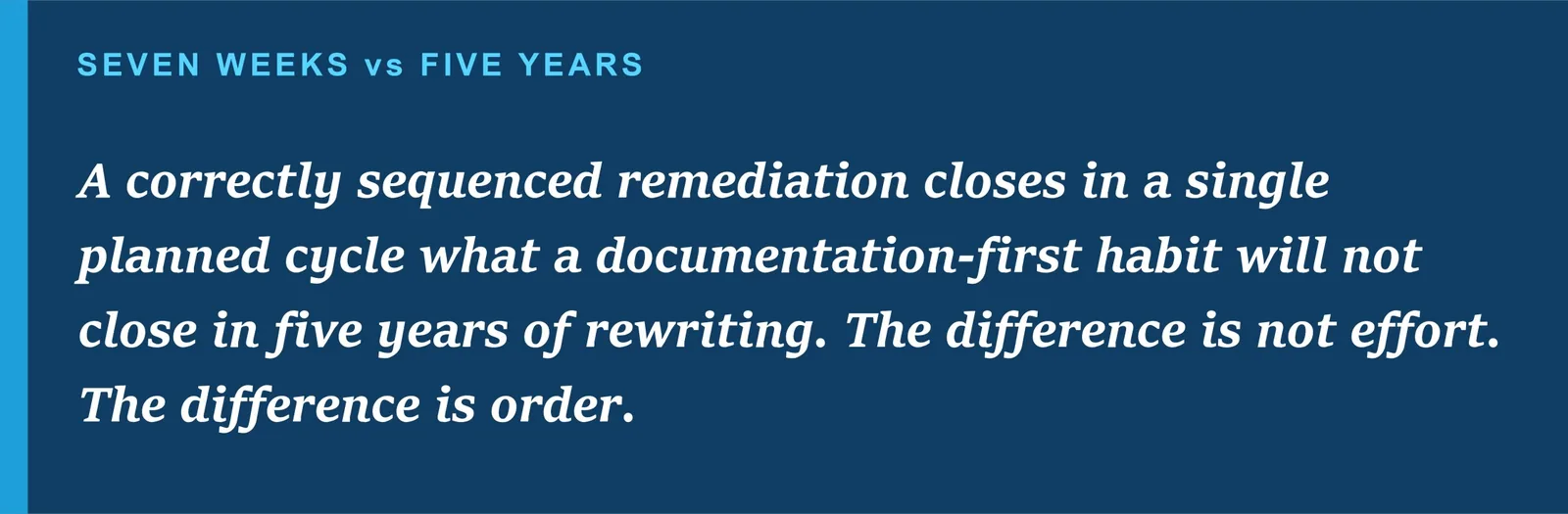
Each stage establishes what the next describes: engineering establishes the SDMBL, documentation describes it, evidence captures the operation, closure validates that all three reconcile. Seven weeks of scheduled work closed a gap that five years of document rewriting did not.
The Strategic Gap The Sequence Inversion Now Opens
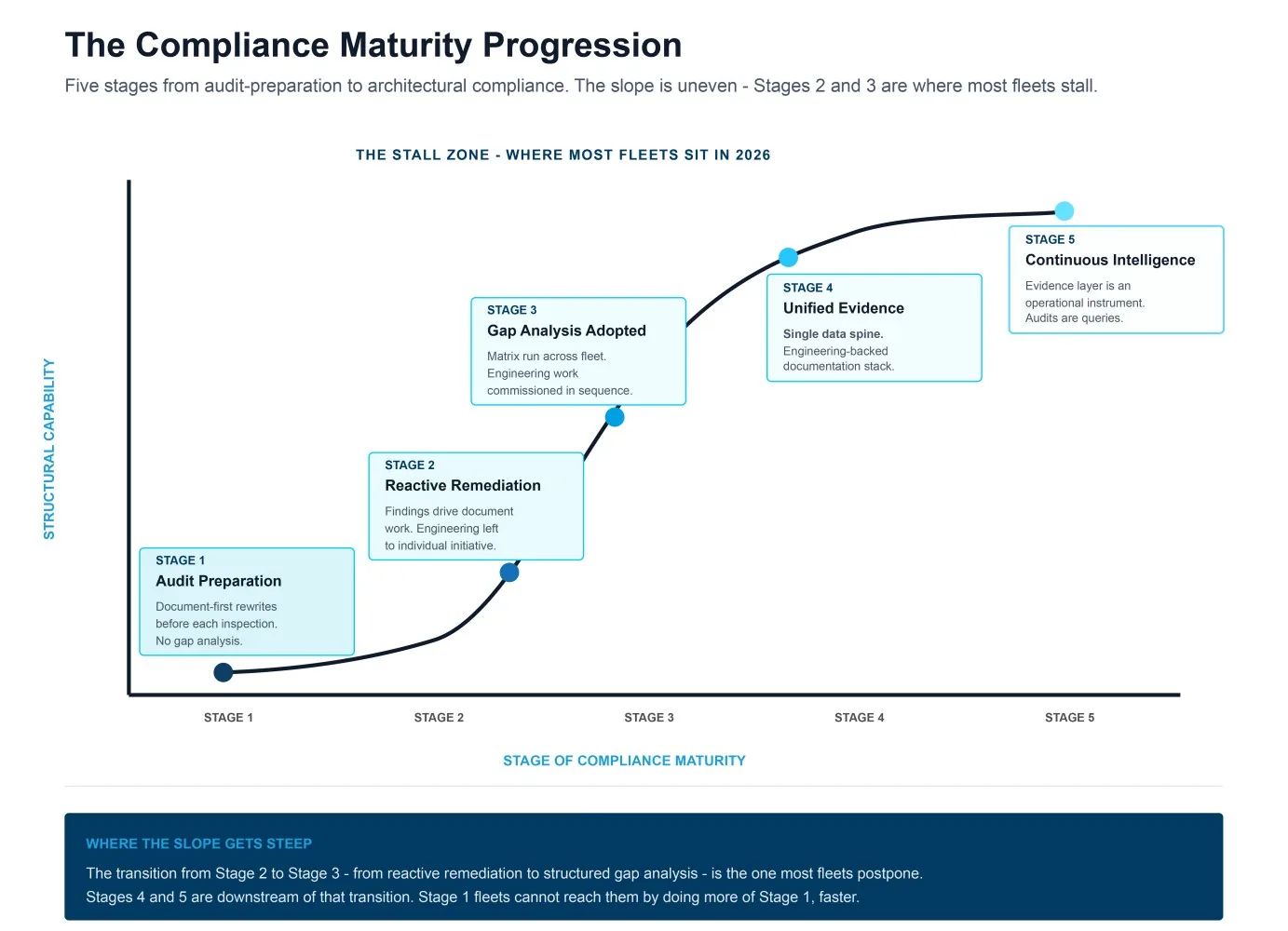
The fleets that have corrected the sequence are not better resourced; they have simply moved the trigger for engineering upstream and built Compliance Intelligence on the evidence layer that flows out of it and the advantage compounds.
Each new framework tightening lands as a maintenance event for the architectural fleet and a new project for the document-first one; one works from a single data spine, the other from four overlapping ones. None of this requires new technology or new people. It requires sequencing differently.
Closing Reflection
Five years of MSMP reissues, LMP refreshes, and procedural updates — well-intentioned and professionally executed — against a finding that kept returning, because the finding was never about what was being fixed. The fleet was fixing what it could see; the frameworks were testing what sat upstream of it.
The message since 2024 was never a request for better paperwork. It was a request for the engineering basis the paperwork was meant to describe, and the operational evidence the engineering was meant to produce. The frameworks will tighten further; whether each tightening lands as a maintenance event or a new project was settled the moment the trigger for engineering work was either moved upstream or left where it had always been.
Where does a fleet actually start? Upstream of the documents. The frameworks have been saying so since 2024.
MARINE LOG X7 is a recurring operational intelligence briefing for marine superintendents, fleet managers, technical directors, vetting and compliance teams, and ship owners navigating the convergence of regulatory, commercial, and operational pressure across the global fleet.
Coming next in Issue #12 The Mooring Engineering Dossier: Ship Design MBL calculation for pre-MEG4 vessels, fittings SWL reconciliation, LDBF and TDBF derivation with worked examples, equipment suitability, and the integrated mooring system design review
MARINE LOG X7
Issue #11 · June 2026 Published by Synergetic Shipping Technologies Pvt. Ltd
Prepared by Capt. Arjun Singh Kalra