Voyage X7: Voyage Reporting & Emissions Compliance Software
A formal vessel voyage reporting system for noon, arrival and departure, and load and discharge reports, built on a structured database and a Standardised Vessel Dataset. Voyage X7 captures positions, bunkers, fuel consumption, cargo and water data once and supports compliance with IMO DCS, CII, EU MRV, EU ETS, FuelEU Maritime and SEEMP.
- IMO DCS
- CII
- SEEMP
- EU MRV
- EU ETS
- FuelEU Maritime
- Noon reports
- Part of Marine X7
- ISO 9001:2015, ISO 27001:2022 & CMMI Level 3 certified team
- 2,200+ vessels use Marine X7 products

A noon report is now regulatory and financial data
Fuel and voyage data used to be shared mainly with the charterer and the technical team. It now drives carbon ratings, verified emissions reports and, in Europe, a carbon cost that the company has to pay, so errors in a noon report can become compliance failures and real money.
Ships of 5,000 GT and above must collect fuel oil consumption, distance and hours under way and report them annually to their Flag Administration to receive a Statement of Compliance.
Since 2023 ships of 5,000 GT and above receive an annual Carbon Intensity Indicator rating from A to E. A ship rated D for three consecutive years, or E in a single year, needs a corrective action plan in its SEEMP.
Ships calling at EU and EEA ports must monitor, report and have verified their fuel consumption and emissions every year under an approved monitoring plan.
Since 2024 shipping is part of the EU Emissions Trading System, with companies required to surrender allowances for a growing share of their verified emissions as the phase-in progresses.
Since 1 January 2025, FuelEU Maritime limits the greenhouse gas intensity of energy used on ships calling at EU and EEA ports, with the limit tightening over time and penalties for shortfalls.
Charterers expect consistent performance data, Port State Control can check DCS and SEEMP documentation, and TMSA 3 expects energy and emissions to be measured and managed across the fleet.
What voyage reporting is costing you today
The data needed for emissions compliance usually starts as a noon report typed onboard, and every weakness in that report is carried forward.
Same data, many formats
Vessels send noon, arrival, departure and cargo reports in different templates for the office, the charterer and the owner, often by email.
Errors that reach the verifier
Typing mistakes in fuel, distance or bunker figures are found late, during DCS, MRV or ETS verification, when correcting them is slow.
Carbon costs you cannot forecast
Without reliable daily fuel and voyage data, it is hard to see where a vessel's CII rating, ETS exposure or FuelEU balance is heading during the year.
Manual reconciliation ashore
Operations and technical teams rebuild bunker and consumption figures in spreadsheets before every report or claim.
Ship-specific details lost
Generic templates do not reflect each ship's cargo spaces, tanks and pumping systems, so cargo and fuel data are hard to interpret.
Missing reports
With reports arriving by email, the office often cannot see at a glance which vessels have not reported for a day.
Emails, Excel templates and copy-paste — or one structured voyage record feeding every report
Voyage data should be entered once onboard, in a standard structure, and reused for operations, performance and every emissions regime.
What sets Voyage X7 apart for your fleet
Voyage X7 is a formal vessel voyage reporting system with structured data and a standardised vessel dataset. It turns daily reports into data that operations, technical and compliance teams can all trust.
Structured, standardised data
A structured database and Standardised Vessel Dataset replace free-format emails and templates, so data is comparable across the fleet.
Built around each ship
Cargo spaces, fuel and other tanks and pumping systems are allocated ship by ship, so reports reflect how each vessel actually works.
One dataset, every regime
The same voyage data supports IMO DCS, CII, EU MRV, EU ETS, FuelEU Maritime and SEEMP.
Part of Marine X7
Voyage data can be analysed alongside other Marine X7 data through Report X7's cross-module reporting.
- Key features
- Structured database for vessel reports
- Standardised Vessel Dataset (SVD)
- Digital access to reports and analytics
- Noon, arrival/departure and load/discharge reporting
- Data for vessel positions
- Data for bunker status
- Data for fuel consumption
- Data for cargo status
- Arrival and departure data
- Cargo load and discharge data
- Fresh and potable water status
- Regulatory compliance for IMO DCS
- Regulatory compliance for the Carbon Intensity Indicator (CII)
- Regulatory compliance for EU MRV
- Regulatory compliance for EU ETS
- Regulatory compliance for FuelEU Maritime
- Regulatory compliance for SEEMP
- Ship-specific cargo space allocation
- Ship-specific fuel and other tanks allocation
- Ship-specific pumping system allocation
Cleaner data, fewer compliance surprises
The return from Voyage X7 comes from getting voyage and fuel data right at source. That reduces the time spent reconciling reports and the risk of an error surfacing during emissions verification.
Fewer verification problems
Structured, standardised entries reduce the inconsistencies in fuel, distance and bunker data that cause questions during DCS, MRV and ETS verification.
Hours saved ashore
Reports are available digitally from one database, so operations and technical teams no longer re-key and reconcile emailed reports.
Earlier sight of emissions exposure
Daily data on fuel consumption and voyages lets the office follow CII, ETS and FuelEU positions during the year instead of discovering them at year-end.
Patterns you can see because the data is standard
Analysis is only as good as the data behind it. Voyage X7 makes fleet-wide analysis possible by making every vessel report the same way.
Comparable fleet data
A Standardised Vessel Dataset means fuel consumption, bunkers and cargo data can be compared across vessels and voyages.
Reporting status at a glance
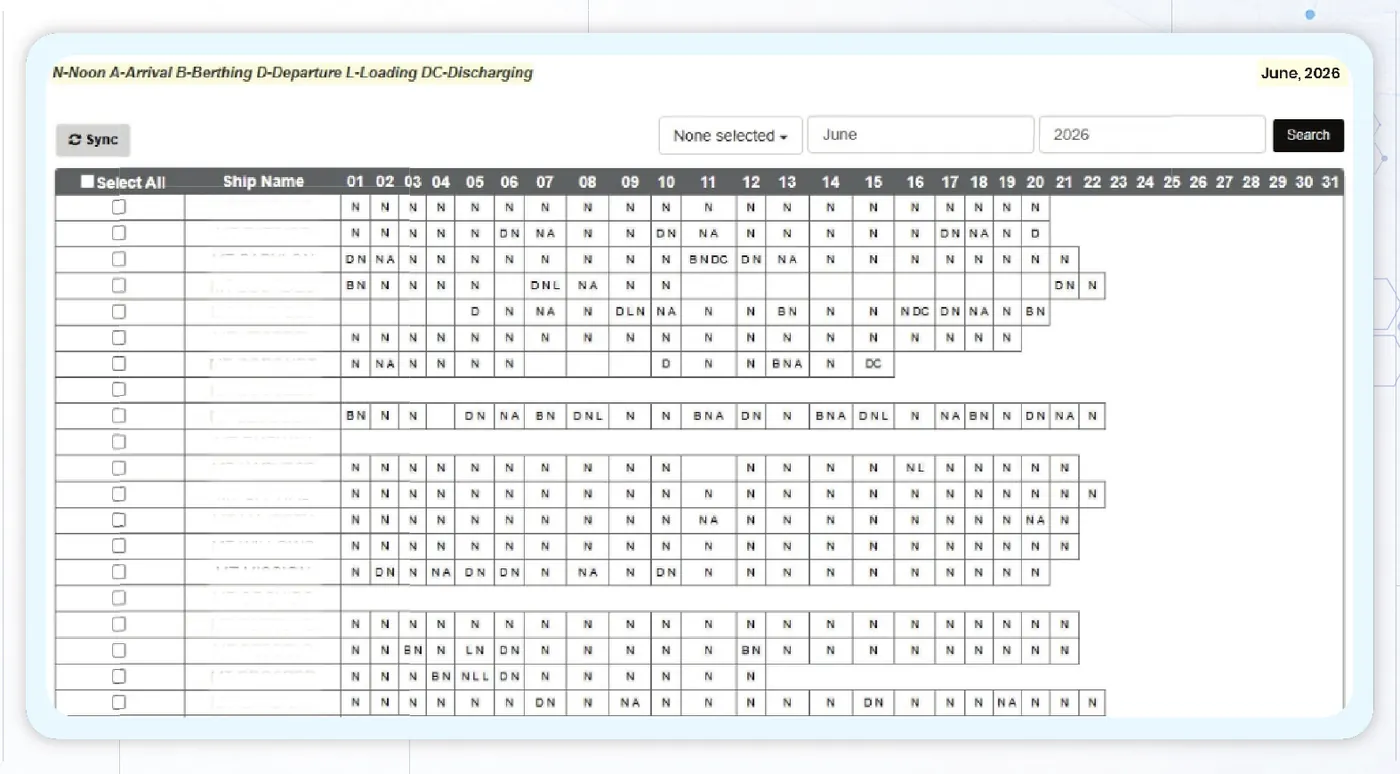
A monthly view shows which reports each vessel has submitted each day, so gaps are visible immediately.
AI reporting with Report X7
With Report X7, voyage data can be queried alongside other Marine X7 modules using artificial intelligence prompts.
Designed for ships and seafarers
Structured forms set up for each ship's tanks, cargo spaces and pumping systems make reports quicker and more accurate to complete onboard.
See every vessel's reporting status for the month
The fleet reporting view shows noon, arrival, berthing, departure, loading and discharging reports for each ship and each day.
- Daily report status for every vessel in the fleet
- Report types: noon, arrival, berthing, departure, loading and discharging
- Missing reports visible at a glance
- Search by vessel, month and year
Built by an ISO 9001, ISO 27001 and CMMI Level 3 certified team
Voyage X7 is part of Marine X7 by Synergetic Shipping Technologies, which is certified to ISO 9001:2015, ISO 27001:2022 and CMMI Level 3. Our class-approved products are DigiMoor X7 and Work-Ship, and PMS X7 is also Class approved.
- ISO 9001:2015 quality management
- ISO 27001:2022 information security
- CMMI Level 3
- Part of the Marine X7 suite
- Suite includes class-approved DigiMoor X7, Work-Ship and PMS X7
Trusted by 70+ ship owners and managers
2,200+ ships use our software, and 3,100+ ships use our software and services every year, with 100% client retention.
Preferred by the World's Leading Ship Owners and Managers
With 100% client retention since inception, we're trusted by LNG, LPG, Oil, Chemical, Bulk, Container & Specialized Fleets globally.






















Learn more about Voyage X7
What is Voyage X7?
Voyage X7 is vessel voyage reporting software from Synergetic Shipping Technologies for noon, arrival and departure, and load and discharge reports. It uses a structured database and a Standardised Vessel Dataset to capture positions, bunkers, fuel consumption, cargo and water status, and supports compliance with IMO DCS, CII, EU MRV, EU ETS, FuelEU Maritime and SEEMP.
Which emissions regulations does Voyage X7 support?
Voyage X7 supports regulatory compliance for IMO DCS, the Carbon Intensity Indicator (CII), EU MRV, EU ETS, FuelEU Maritime and SEEMP.
Can Voyage X7 be set up for each ship's layout?
Yes. Voyage X7 includes ship-specific allocation of cargo spaces, fuel and other tanks, and pumping systems, so each vessel reports against its own arrangement.
Can Voyage X7 be used on its own?
Yes. Any Marine X7 module, including Voyage X7, can run standalone. It can also be used with Report X7 for cross-module reporting and analytics.
See Voyage X7 with your own vessel reports
Book a walkthrough with our team. Bring a month of noon and port reports from one vessel and we will show you how Voyage X7 structures them for operations and emissions compliance.