Why a single mooring operation is now scrutinised through four co-equal compliance frameworks three international, one terminal and why the evidence chain breaks at the seams between them.
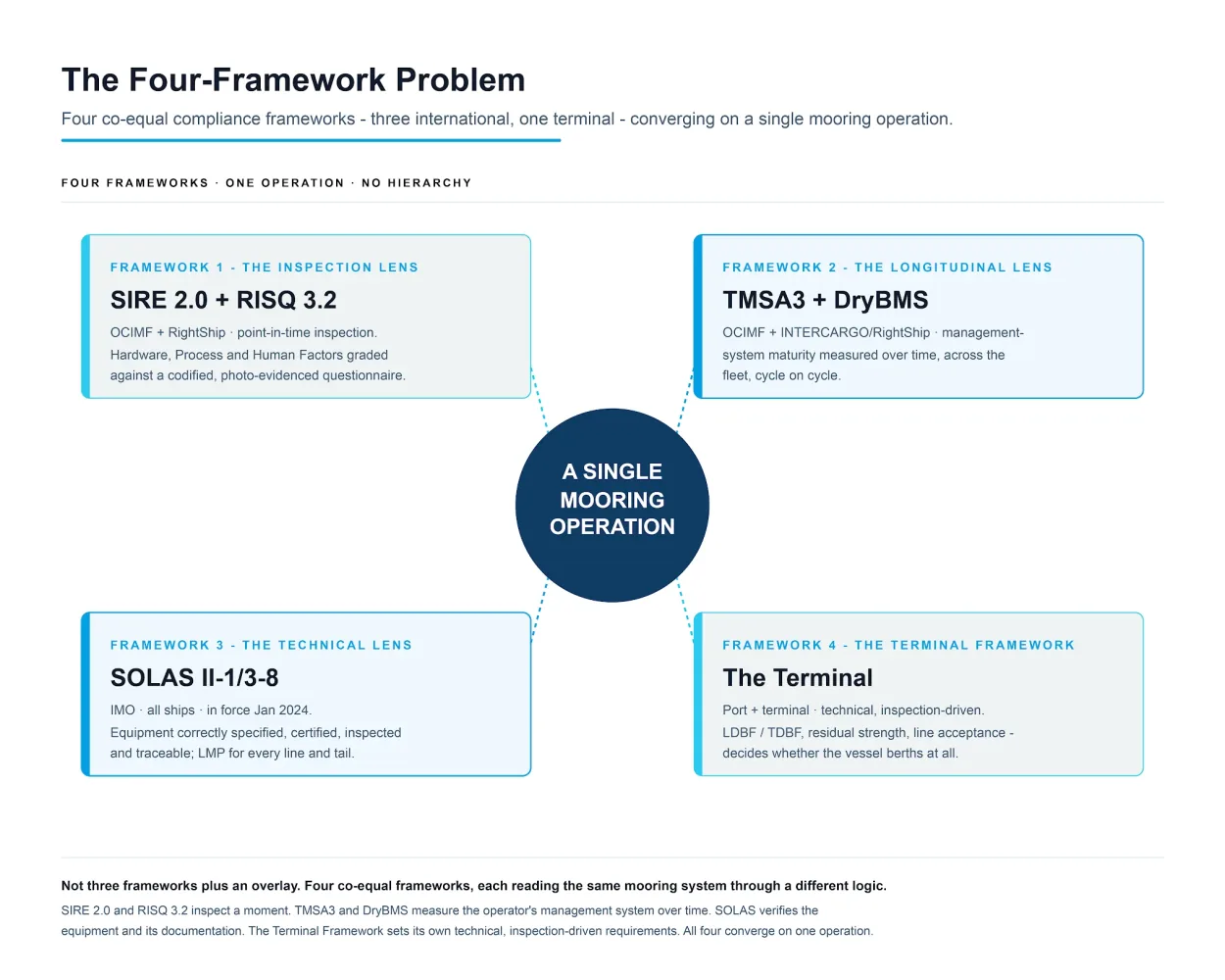
Somewhere this morning, a chief officer stepped onto a wet, windswept deck to begin a routine mooring operation. By the time the last spring line was made fast, that single event had quietly generated obligations under four separate compliance frameworks each measuring something different, each capable of independently downgrading the vessel's commercial standing. Three are international; the fourth belongs to the terminal the vessel had just made fast to, and at a growing number of ports it decides whether the vessel berths at all.
Mooring in 2026 is no longer a rope-and-winches problem; it is a data problem wearing a rope-and-winches costume. The same forty-five-minute operation is now read simultaneously by SIRE 2.0 and RISQ 3.2 inspectors, by TMSA3 and DryBMS self-assessment cycles, by SOLAS II-1/3-8 port-state verification of the post-MEG4 regime, and by terminal frameworks that increasingly require more than the IMO baseline.
Four frameworks. One operation. Zero margin for fragmented evidence.
Any disconnect between the four creates audit risk, vetting risk, and commercial risk simultaneously. The structural fix is not more paperwork it is a unified mooring data layer that turns operational events into compliance evidence, and into compliance intelligence, by default.
The Four Frameworks, Explained Simply
The four frameworks are not redundant; they are deliberately complementary which is what makes them impossible to satisfy through any single workflow:
•The inspection lens SIRE 2.0 and RISQ 3.2. Point-in-time, inspection-event instruments. SIRE 2.0, OCIMF's risk-based tanker regime that replaced VIQ7 in September 2024, grades Hardware, Process, and Human Factors against codified Performance Influencing Factors. RISQ 3.2, RightShip's dry-side counterpart tightened from February 2026 and now the core of RightShip inspection preparation, anchors on SOLAS, IACS, and MEG4. Both feed the commercial scoring used by charterers, terminals, and financiers. The question: what did the inspector see on board today?
•The longitudinal lens TMSA3 and DryBMS. The management-system maturity frameworks TMSA3's Element 6A covers mooring specifically; DryBMS is its dry-bulk equivalent. The question: is your management of mooring maturing in a measurable, evidence-supported way, or is it static?
•The technical lens SOLAS II-1/3-8. The IMO's mandatory regime for mooring equipment, in force since 1 January 2024, pulling in MSC.1/Circ.1175 Rev.1 (equipment design and the Ship Design MBL), 1619 (new ships), and most consequentially 1620, which requires every SOLAS vessel to maintain a Line Management Plan (LMP). The question: is the equipment correctly specified, certified, inspected, and traceable?
•The Terminal Framework Not a footnote and not an overlay a fourth, co-equal framework, technical and increasingly inspection-driven. The question: can you prove, against our specific thresholds, that this mooring system is fit to be at this berth right now?
The trap: all four read the same operation but measure different things. SOLAS compliance does not save you from a Human Factors finding; a clean inspection does not lift a TMSA3 stage; a strong stage does not prevent a detention over one tail's certificate; and none of the three international frameworks satisfies the terminal you actually berth at.
Why Mooring Became a Data Problem
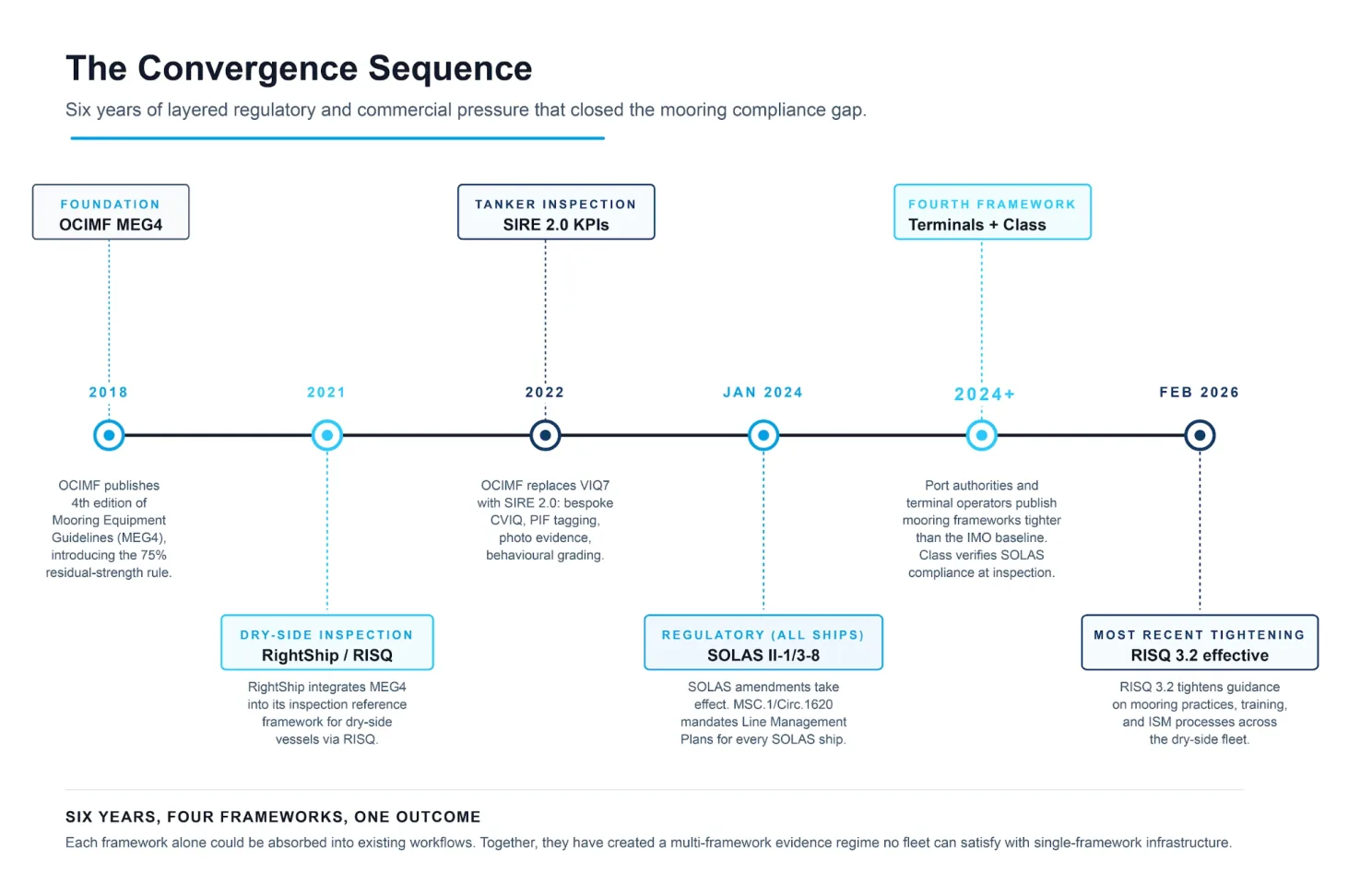
For decades, mooring sat in a regulatory dead zone too operationally specific for convention, too hardware-heavy for behavioural standards, too routine for analysis. That zone closed between 2018 and 2024: MEG4 redefined the engineering basis and introduced the 75% residual-strength retirement criterion measured against the Ship Design MBL; SIRE 2.0 set the KPIs to verify MEG4 compliance at inspection; RISQ 3.2 followed; and SOLAS II-1/3-8 made Line Management Plans mandatory fleet-wide. A mooring deck is now read the way a doctor reads a blood panel not as the disease, but as the most reliable signal of systemic health. A single observation a mistagged tail, an uncalculated SDMBL, an unreconciled fittings SWL can cascade across all four frameworks in ways a unified dataset would absorb and a fragmented one amplifies.
The Fourth Framework - The Terminal
The Terminal Framework varies most: requirements are set port by port, evolve independently of IMO timelines, and across Australia, South America, and beyond now demand more than the IMO baseline. Terminal frameworks routinely extend the vessel's LMP and Mooring System Management Plan (MSMP) beyond that baseline; specify LDBF and TDBF as multipliers of the Ship Design MBL; set minimum line and spare counts; define retirement on whichever comes first 75% residual strength, the manufacturer's instructions, or operational experience; and require manufacturer certificates and documented line-condition evidence for every line and tail.
Residual strength testing is the Terminal Framework's instrument of choice: a line that looks serviceable and carries valid certification can still be challenged if its residual strength against the 75% Ship Design MBL criterion cannot be evidenced. The question is no longer “is the paperwork present?” but “can you prove this line is still strong enough to be here?”
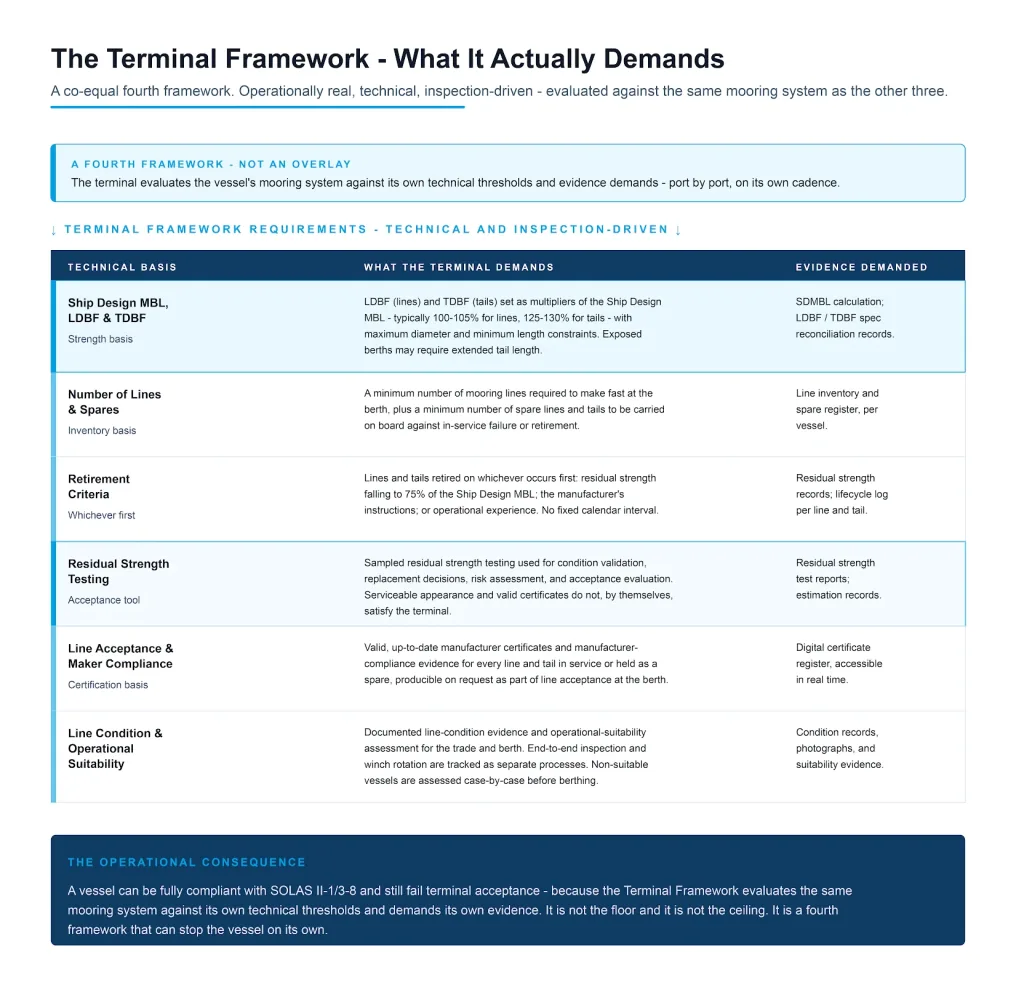
A vessel can be fully compliant with SOLAS II-1/3-8 and still be turned away for failing a threshold the terminal set tighter than the baseline. Not three frameworks plus an overlay — four co-equal frameworks, each reading the same mooring system through a different logic, each capable of stopping the vessel on its own.
How One Mooring Event Flows Through the Compliance Stack
The clearest way to see the problem is to follow a single operational moment through the evidence pipeline:
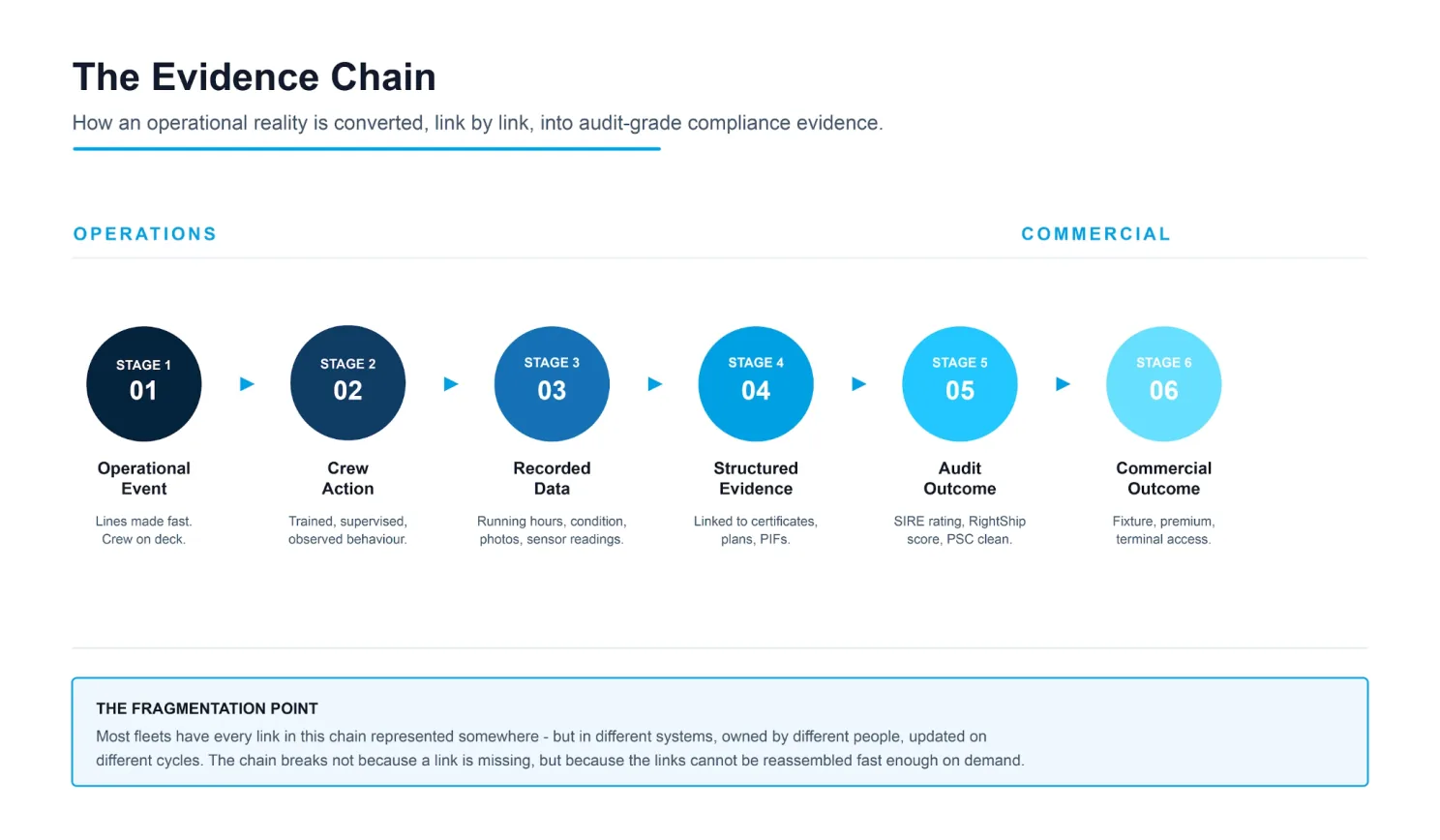
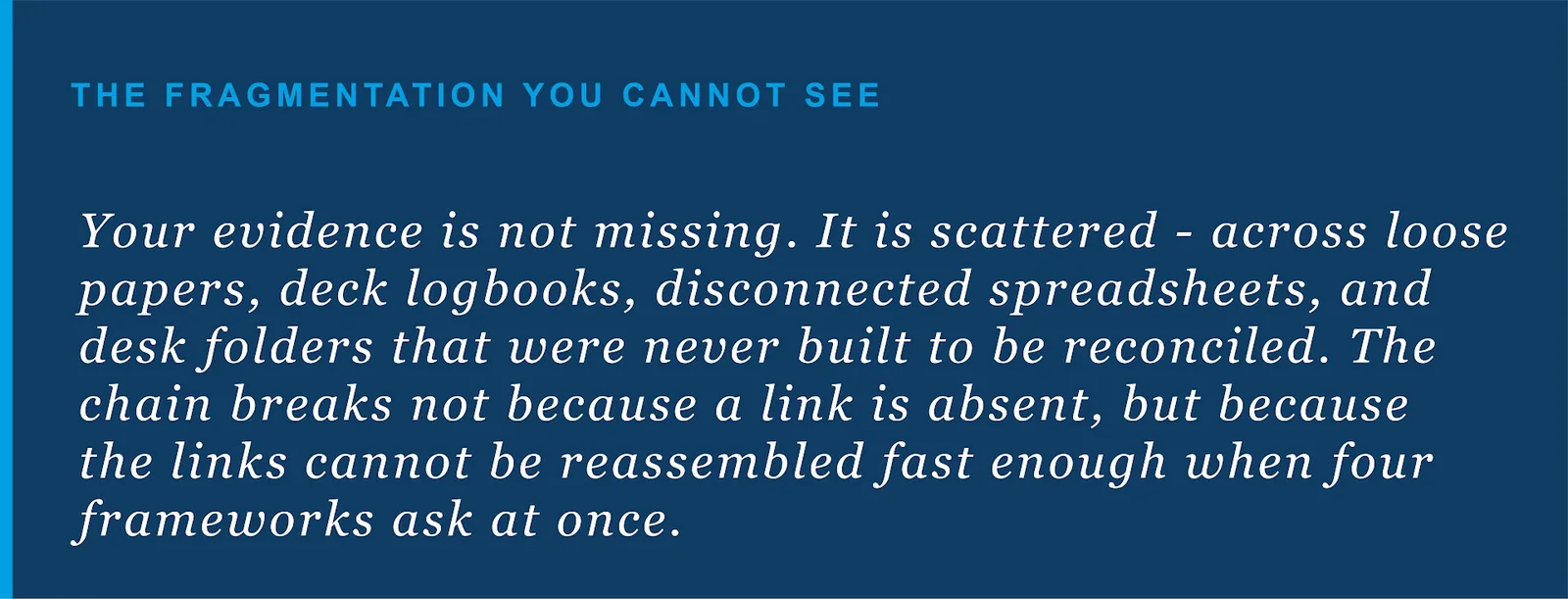
The four streams do not converge until the very end where charterers, port-state inspectors, terminal acceptance teams, and underwriters make decisions. If your collection systems are also independent one app for inspections, a spreadsheet for line records, a deck logbook, a folder of certificates you are forcing four parallel streams to reconcile data never designed to be reconciled. That cost is invisible until it isn't.
What "Evidence" Now Means and Why It Is Really an Intelligence Problem
The meaning of evidence has changed across all four frameworks and most operators are still working to the previous definition. Under the previous regime, evidence meant records: hard-copy MSMPs on the bridge, an LMP in a binder, certificates in a desk folder ashore. Under the current regime, evidence means ship-specific, manufacturer-specific, lifecycle-traceable data that reconciles across all four frameworks at once plans harmonised with the ship's actual design (Ship Design MBL, fittings SWL, LDBF, TDBF), running hours and condition per line and tail, residual strength tracked against the 75% criterion, and compliance state queryable in real time rather than reconstructed before the next mooring audit.
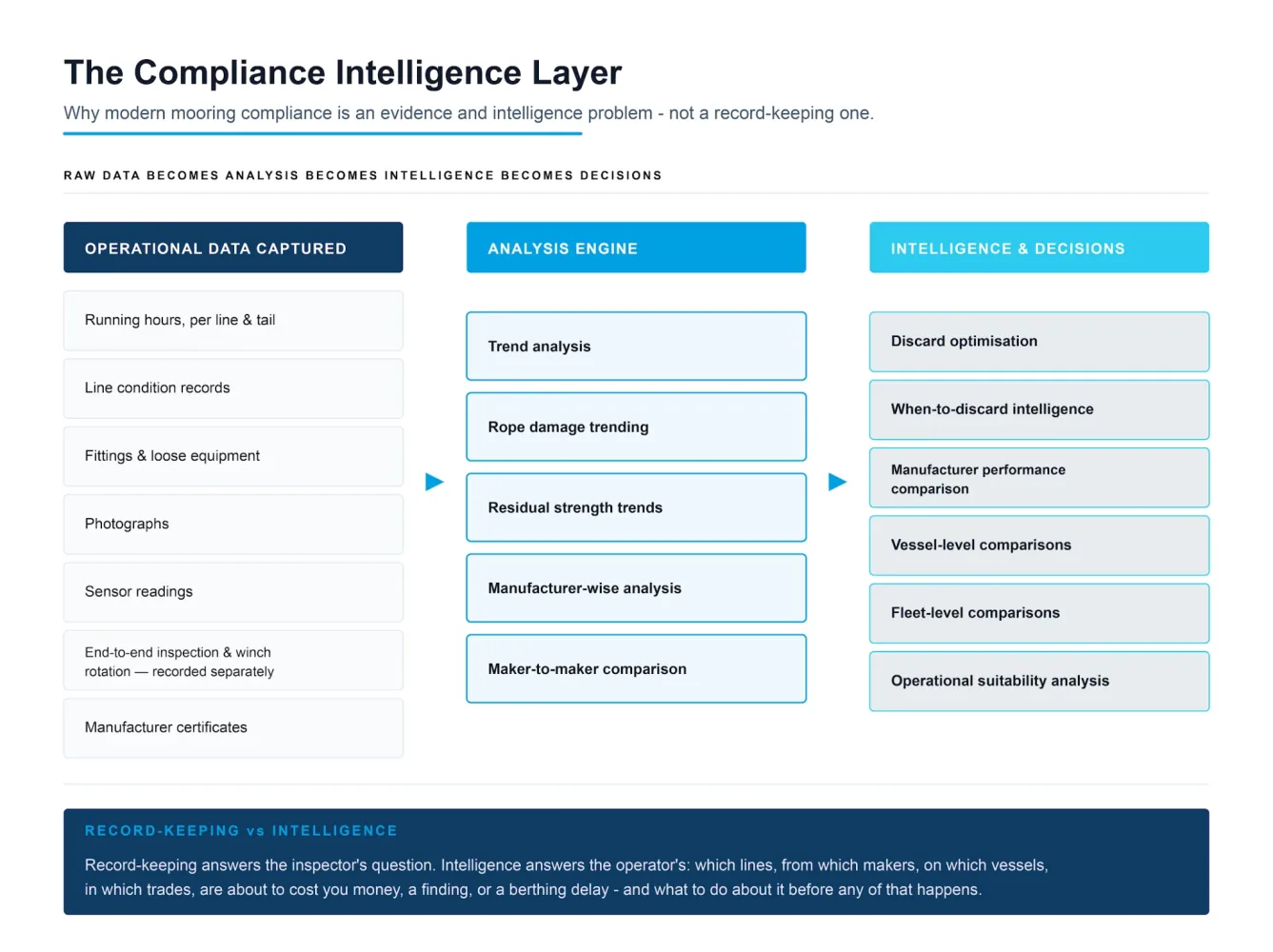
The deeper shift: this is no longer a record-keeping problem but an intelligence problem. The frameworks increasingly reward analysis rope damage trending that surfaces a wear pattern before it becomes a finding; residual strength decay tracked line by line; maker-to-maker comparisons that reveal which supplier's rope actually survives a given trade; discard optimisation that extracts full safe life from each line. Record-keeping answers the inspector's question. Intelligence answers the operator's: which lines, from which makers, in which trades, are about to cost you money, a finding, or a berthing delay and what should you do before any of that happens?
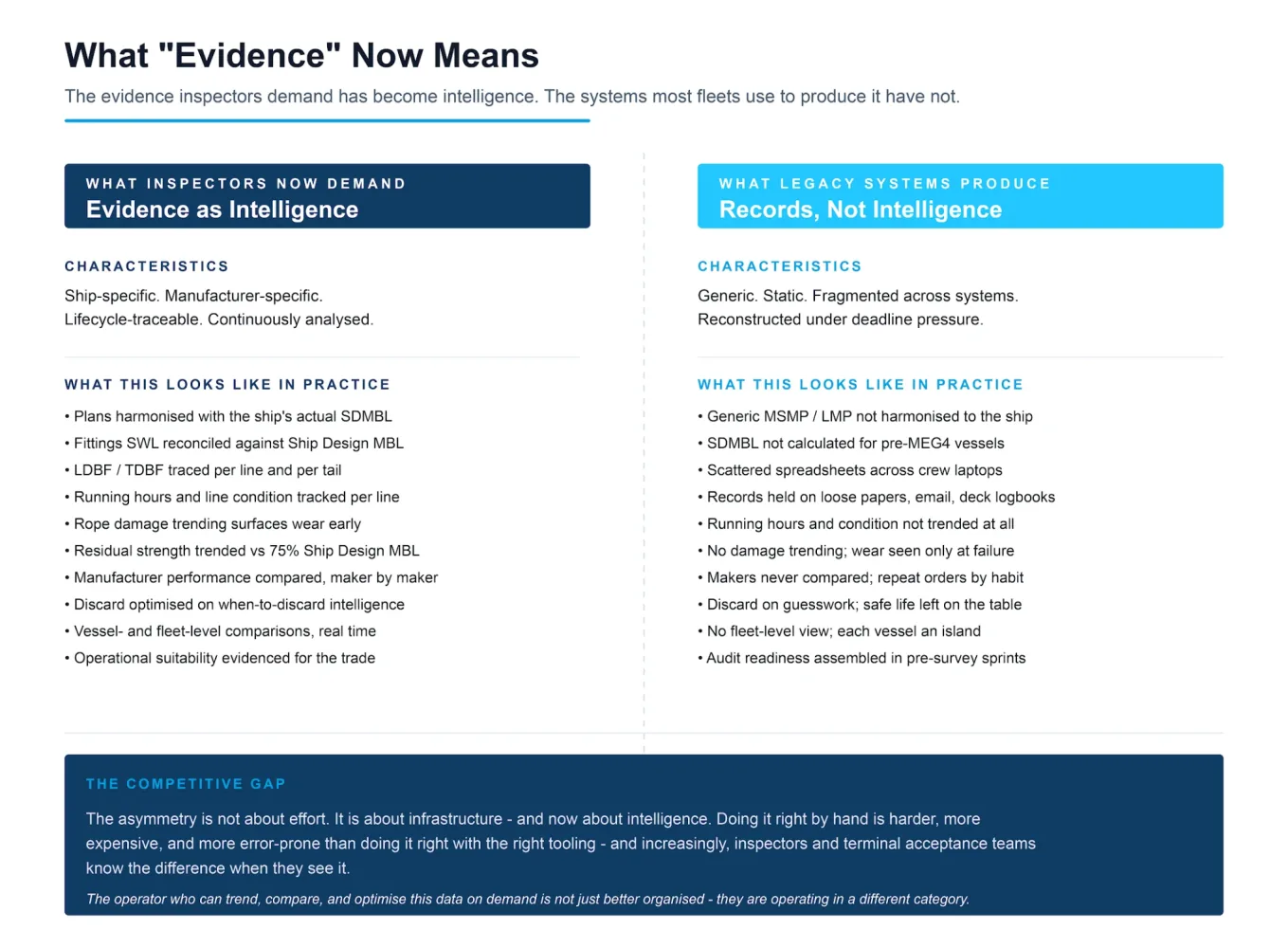
This gap quietly defines competitive standing in 2026 and it is the real dividing line for mooring management software and maritime compliance software generally. The operator who can produce lifecycle-traceable evidence and turn it into intelligence on demand is operating in a different category from the one still maintaining scattered spreadsheets. The asymmetry is not about effort; it is about infrastructure and inspectors and terminal acceptance teams know the difference when they see it. SIRE 2.0 compliance software that merely stores documents does not close that gap.
The Hidden Cost of Fragmented Compliance
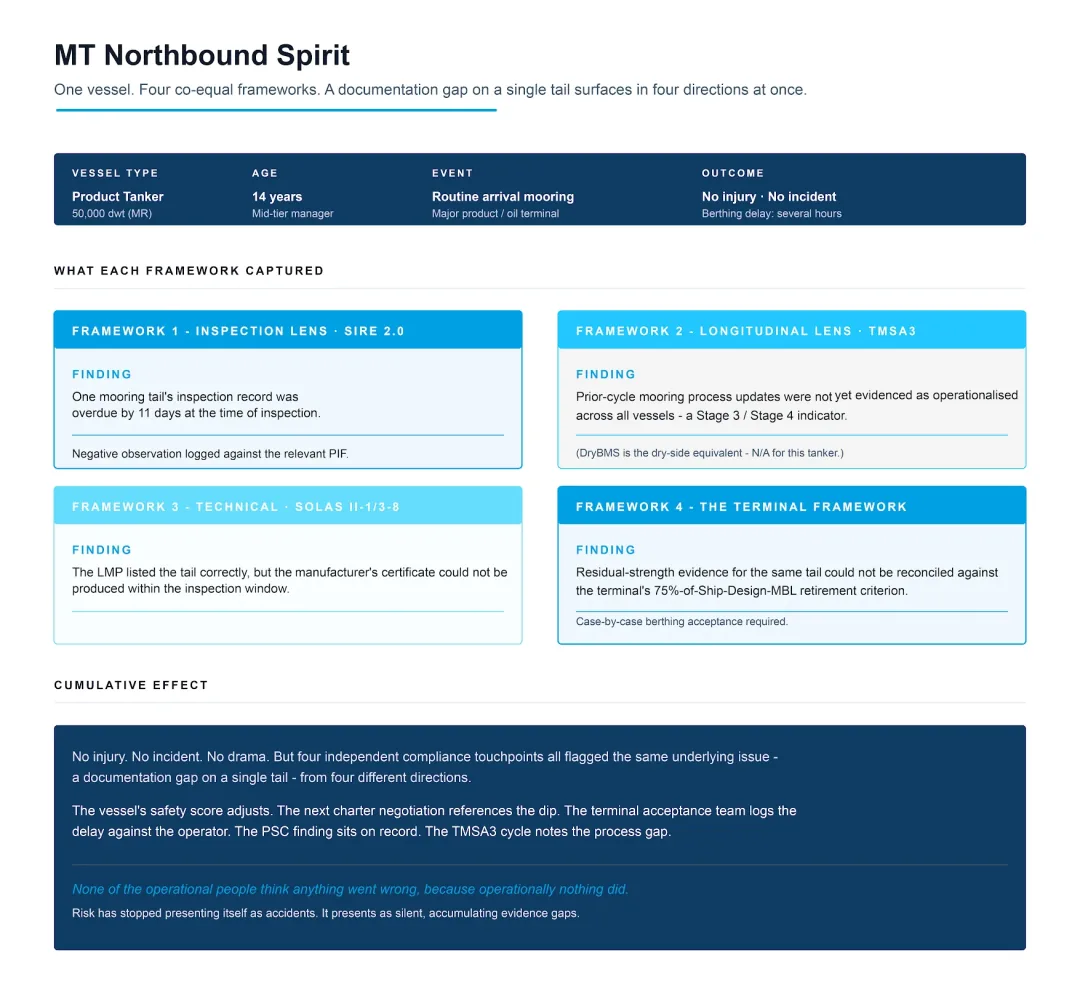
Most operators have every link of the evidence chain represented somewhere in different systems, owned by different people, updated on different cycles. The chain breaks not because a link is missing, but because the links cannot be assembled fast enough when an inspector, a vetting analyst, a port-state officer, and a terminal acceptance team ask for them in sequence. The symptoms are familiar: a superintendent reconstructing a drill record the night before an inspection; a retirement decision delayed two weeks for a missing test certificate; a vessel held outside a terminal because one line's residual-strength evidence cannot be produced despite full IMO compliance.
None of this looks like money, but that is what it is. Industry benchmarks suggest a mid-sized fleet on fragmented infrastructure leaves multi-million-dollar value on the table every year across rope lifecycle, procurement, pre-arrival risk, and compliance overhead. Risk no longer presents itself as accidents. It presents as silent, accumulating evidence gaps that translate, eventually, into commercial pressure.
What "Audit Readiness" Now Means
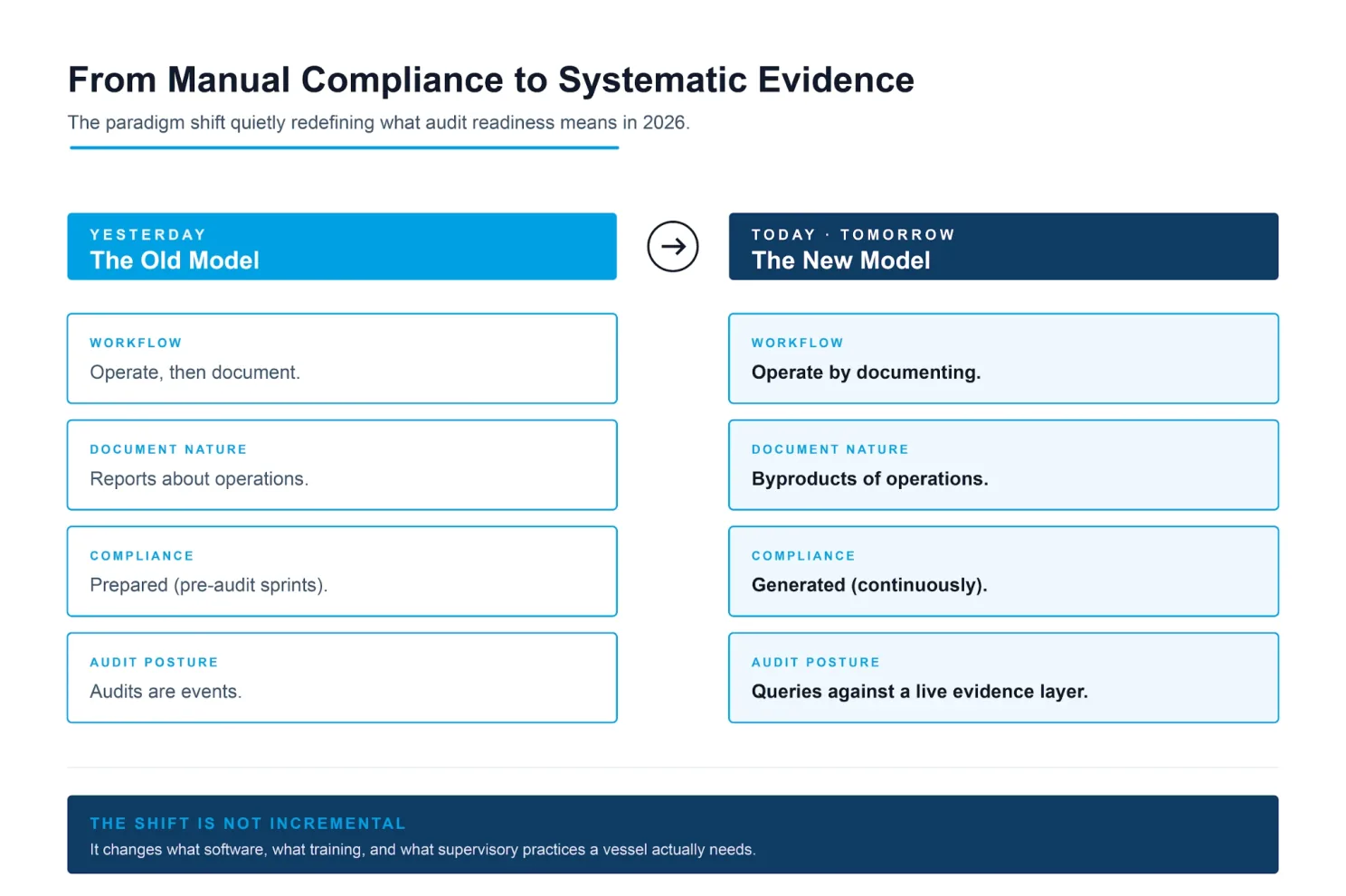
For a decade, audit readiness was a project intensive SIRE 2.0 preparation or pre-vetting inspection sprints for tankers ahead of a known window, relaxed afterward. That cadence is no longer viable. SIRE 2.0 and RISQ 3.2 outcomes persist and feed scoring models that read across cycles; TMSA3 and DryBMS are longitudinal by definition and cannot be staged the day before; SOLAS Line Management Plans are continuous obligations; terminal reviews can happen on any port call, often pre-arrival. Audit readiness has shifted from a state you enter to a state you maintain and the fleets that will compete into 2027 are those that have moved evidence collection upstream, into the operation itself.
The Future of Mooring Compliance
Three trends will compound the problem. The frameworks are becoming more data-hungry, not less SIRE 2.0's PIF taxonomy is built to generate richer behavioural data, and RISQ 3.2 has tightened mooring guidance again. Terminal frameworks are getting denser recent revisions have added training mandates, equipment requirements, and tighter retirement criteria. And the commercial consumers of compliance data charterers, terminals, insurers, financiers are becoming more analytically sophisticated. The audience for your compliance evidence is no longer a single inspector with a clipboard; it is a network of algorithms.
From Manual Compliance to Systematic Operational Evidence
SIRE 2.0 and RISQ 3.2, TMSA3 and DryBMS, SOLAS II-1/3-8, and the Terminal Framework are not four separate problems. They are four views into one: can your fleet produce continuous, structured, multi-framework evidence and analyse it as a natural byproduct of how it operates? The manual-craft model worked when there was one inspector, one questionnaire, and one report. It does not survive four co-equal frameworks, multiple databases, and an underwriter's automated risk engine.
The fleets ahead of the curve have begun the structured work a TMSA gap analysis, DryBMS gap analysis, and RISQ gap analysis run across all four frameworks; a MEG4 mooring equipment gap analysis and engineering assessment where required; MSMP and LMP redrafting where the documents no longer fit the vessel or the trade. The fleets behind this curve have not. There is no third option. Which side of that line is your fleet on this quarter and if you do not know, how would you find out?
MARINE LOG X7 is a recurring operational intelligence briefing for marine superintendents, fleet managers, technical directors, vetting and compliance teams, and ship owners navigating the convergence of regulatory, commercial, and operational pressure across the global fleet. Coming next in Issue - Where Does a Fleet Actually Start? The structural answer to the question this issue closes on. A deep dive into Gap Analysis and Mooring Engineering Assessments: SDMBL calculation for pre-MEG4 vessels, fittings SWL versus Ship Design MBL reconciliation, MSMP and LMP redrafting, mooring systems design review, and the engineering assessment methodology that converts diffuse risk across four frameworks into a prioritised, sequenced remediation plan a board can sign off on.
MARINE LOG X7
Issue #10 · May 2026 Published by Synergetic Shipping Technologies Pvt. Ltd.
Prepared by
Capt. Arjun Singh Kalra · Sachin Sikka