MEG5 Is Coming: What Mooring Managers Should Fix Before the Revision Lands
OCIMF has started the revision of its Mooring Equipment Guidelines. MEG4 was published in 2018, and OCIMF is now collecting industry feedback for the next edition, MEG5. Nobody knows the final text yet. The ships that will handle the change best are the ones whose mooring systems already meet MEG4 on engineering, not just on paper.
What has OCIMF actually announced?
OCIMF has opened a feedback survey for the MEG revision and a comment register on MEG4 content. Comment registers are due by 23 October 2026. The survey asks where MEG5 should give clearer, more practical guidance. It names bunkering, ship-to-ship transfer and prolonged mooring, and asks whether Human-Centred Design has changed how equipment is built.
There is no published MEG5 draft and no release date. Anyone telling you exactly what MEG5 will require is guessing.
Why fix MEG4 gaps now if MEG5 will change things?
MEG5 is a revision, not a new start. The core of MEG4 is unlikely to be thrown away: Ship Design MBL, line design break force, brake holding capacity, the Mooring System Management Plan and the Line Management Plan. A ship that can't show those numbers today will be further behind when the new edition arrives.
The regulatory baseline also isn't waiting for OCIMF. The SOLAS II-1/3-8 amendments have applied since 1 January 2024. Under them, all ships need inspection and maintenance of mooring equipment in line with IMO MSC.1/Circ.1620. [VERIFY: link to the IMO circular page]. SIRE 2.0, RISQ 3.2 and terminal questionnaires already test the evidence.
Which five gaps should you close before MEG5?
- No verified Ship Design MBL. Many ships carry ropes chosen by price or habit, with no SDMBL from the original design to measure them against. Without that number, line selection, brake settings and tail choice are guesses.
- Brake settings nobody can evidence. MEG4 expects brakes to render at a set percentage of SDMBL and to be tested. Crews often record "brake tested" with no value, date or method.
- Line records that stop at the purchase order. Running hours, operations, inspections, end-for-ending and retirement criteria live in an Excel file on one ship or in nobody's file at all.
- An MSMP written before the gap analysis. Fleets write the Mooring System Management Plan first and check the equipment later. That order is backwards, and it is why plans fail at inspection. We set this out in Where Does Mooring Compliance Start?.
- Snap-back thinking instead of system thinking. Painted snap-back zones were taken out of MEG4 guidance because they gave a false sense of safety. Crews still need training on the whole mooring area as a danger zone.
[CAPT. INPUT: one short example from a gap analysis you ran, e.g. the most common mismatch you find between installed ropes and SDMBL. No client name.]
What should a mooring manager do this quarter?
- Run a MEG4 gap analysis on your worst-documented ship first, not your newest one.
- Put SDMBL, brake test values and line records into one system that the office can see.
- Rewrite the MSMP only after the gap analysis, so the plan describes the ship you actually have.
- If you have operational lessons OCIMF should hear, send them through the survey before 23 October.
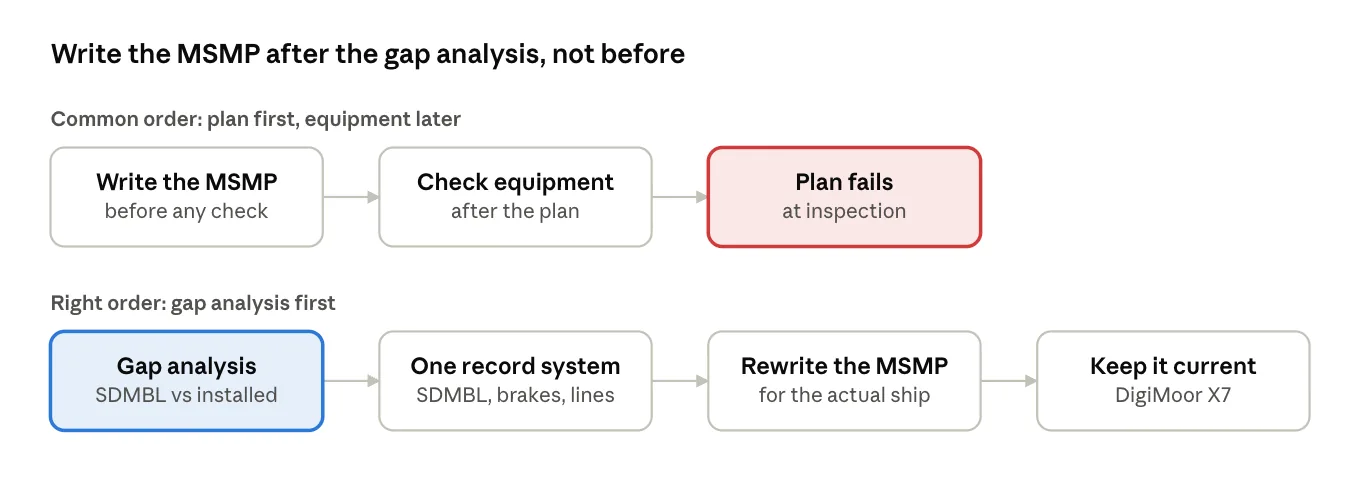
Our Mooring System Gap Analysis & Engineering Assessment does the first step. DigiMoor X7 keeps the records current afterwards.
Check your own ship in 10 minutes: the free Mooring Fittings & System Compliance Calculator.
FAQ
Is MEG5 published? No. As of October 2026 OCIMF is collecting feedback for the revision. No draft or release date has been announced.
Is MEG4 still the standard to follow? Yes. MEG4 (2018) is the current edition and the reference that SIRE 2.0, RISQ and terminals use today.
Do the SOLAS 2024 mooring amendments apply to existing ships? Yes, for inspection and maintenance. The design requirements apply to new ships. [VERIFY: wording against MSC.474(102)]
What is the first step towards MEG compliance? A gap analysis that compares the installed equipment with the ship's design MBL. The MSMP should be written after it, not before.